
Materials & Catalysis
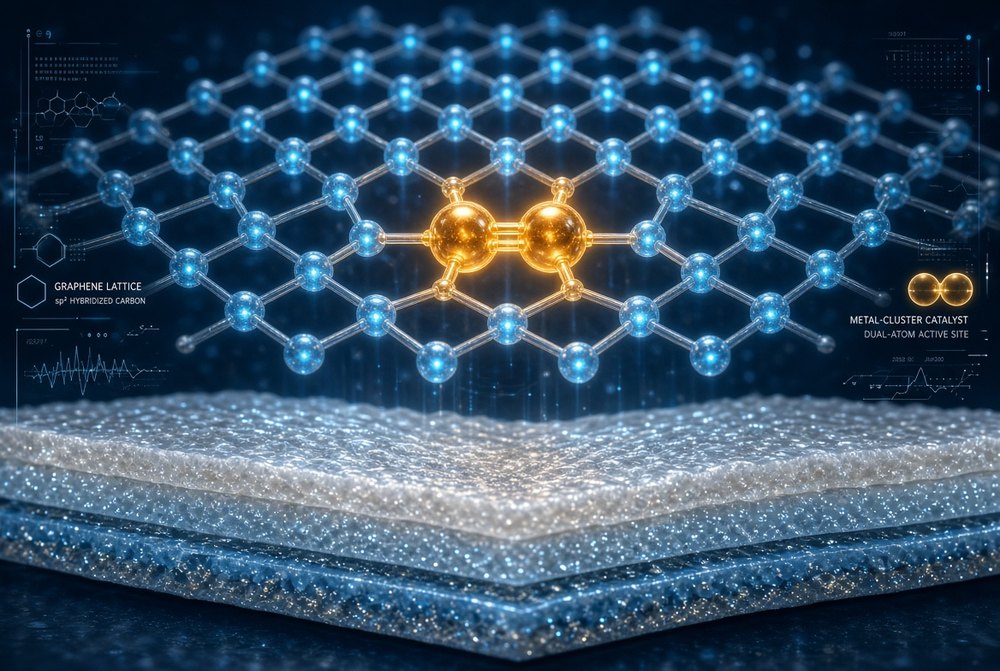
Rhenium-based chemistry and advanced materials: catalysts, protective coatings, aerogels and self-sealing cryogenic systems.
In Situ Eutectic Ultra-High Temperature Ceramic Coatings
Reusable launch vehicles and hypersonic re-entry vehicles experience surface temperatures that routinely exceed 2000 C on leading edges and nose tips. Conventional ultra-high-temperature ceramic (UHTC) coatings based on hafnium or zirconium diboride offer high melting points but remain vulnerable to thermal-shock cracking and delamination caused by coefficient-of-thermal-expansion mismatch with the underlying composite substrate.
This paper describes a coating architecture that forms its final microstructure in situ during the first high-temperature exposure. A precursor layer of HfB2 or ZrB2, SiC and finely dispersed rhenium-based intermetallic particles is applied to a carbon-carbon or ceramic-matrix-composite substrate. When the surface temperature reaches approximately 1800-1950 C the constituents undergo a localized eutectic reaction that produces an interwoven multiphase network whose expansion behaviour more closely matches the substrate. The rhenium-rich particles act as crack-arrestors at grain boundaries. Simultaneously, controlled oxidation of the matrix generates a viscous hafnium-borosilicate glass that flows into surface microcracks and remains adherent under hypersonic shear. The result is a self-healing, thermally compliant coating intended for repeated re-entry cycles.
Cluster-Stabilized Topological Graphene Aerogels
Long-duration deep-space missions and reusable cryogenic stages require insulation that remains dimensionally stable at liquid-hydrogen temperatures, adds very little mass, and provides at least modest attenuation of ionizing radiation. Conventional polymer foams become brittle and crack after repeated cryogenic cycling in vacuum. Multi-layer insulation is thermally efficient but offers almost no radiation protection and loses performance when compressed.
This paper describes a graphene aerogel whose open-cell network is locked at the sheet junctions by in-situ formed metallic nano-clusters. Two practical variants are defined: a lower-metal thermal-primary grade optimised for minimum conductivity and maximum recovery, and a higher-metal radiation-enhanced grade that trades a modest increase in density for improved secondary-radiation attenuation. An optional thin hermetic skin prevents gas and moisture ingress. The material is intended to be applied directly to tank walls or instrument enclosures as a compliant blanket.
Autonomous Cryogenic Two-Stage In-Loop Sealing of Microdefects Using Circulating Nanocapsulated Agents
Operation of large-scale cryogenic installations-particle accelerators, fusion reactors, space propulsion stages and quantum systems-demands continuous maintenance of leak-tightness in coolant and liquefied-gas circulation loops. Conventional methods for locating and repairing microleaks through intergranular pores of structural materials and microcracks in welded joints require complete shutdown of equipment, prolonged thermal recovery of isolated sectors and external mechanical intervention.
This publication presents a method of Autonomous Cryogenic Two-Stage In-Loop Sealing (ACTIS) in which the working cryogenic fluid itself serves as the carrier medium for functional nanocapsules. The ACTIS method relies on thermodynamic, mechanical, and electro-inductive triggers operating in a dual-stage sequence. Upon entering a microdefect, the vitrified nanocapsules undergo localized geometric confinement and steric jamming driven by hydrodynamic pressure. This forms a temporary solid-state restriction that anchors the agent within the fissure, enabling subsequent thermal activation and polymerisation without cycle interruption.
Order-of-magnitude estimates, drawn from scaling considerations and available literature data, indicate that a typical sub-micron to micron-scale defect (width 0.1-10 um, length 10-100 um) requires a sealing-agent volume of 10-15-10-12 L. At capsule concentrations not exceeding 0.05 wt% and volume fractions 10-4-10-3, filling is expected to be achieved within the flow transit time (milliseconds to seconds) by means of a hybrid mechanism. The influence of the particles on the properties of superfluid helium-II at these concentrations is assessed as negligible on the basis of existing dispersion studies, though this remains subject to direct experimental verification.
A differentiation matrix of technological solutions is proposed, separating the architecture of agents and auxiliary equipment into two independent categories: direct integration into existing systems without modification of their geometry, and incorporation into newly designed installations.
The document records the conceptual architecture, protective mechanisms, agent modifications, order-of-magnitude quantitative estimates and the invention formula at the stage of scientific exploration and invention - prior to prototyping and laboratory experiments. The publication establishes worldwide priority (prior art).
Cost-effective Production Technology of Catalyst Systems for Hydrogenation Processes in the Petrochemical Industry and Organic Synthesis
The development of catalytic systems with active centres based on refractory transition metals is one of the problems of modern inorganic chemistry. Many composite materials are known, for example copper-diamond, tungsten-copper protected with rhenium by plasma-enhanced CVD for rocket components, and rhenium-tungsten carbide. This work presents a process for producing a catalytically active copper-rhenium composite material by low-temperature gas-phase thermal decomposition of organometallic compounds.
Chemical vapour deposition (CVD) remains one of the most promising coating methods, but the choice of starting compounds is still a problem. They must be highly volatile at relatively low process temperatures, stable below the operating temperature, and give a vapour concentration high enough for an optimal growth rate of the metal deposit. Chlorocarboxylates of dirhenium(III) satisfy these requirements.
They are proposed for obtaining rhenium composite materials, rhenium coatings, high-purity refractory metals and rhenium catalysts, and other catalytic systems for the hydrogenation of ethylene and for the conversion of carbon-hydrogen mixtures into methane, as well as for anticorrosive coatings and for the neutralization of ecologically hazardous emissions.
Related technologies in other sections
Efficient Technology for Precious, Rare and Refractory Metals Extraction from Secondary Raw Materials
Extraction of precious, rare and refractory metals, including rhenium, from secondary raw materials.