
Robotics
Mechanical and hydraulic architectures for legged and adaptive machines, built around elements that perform several functions at once.
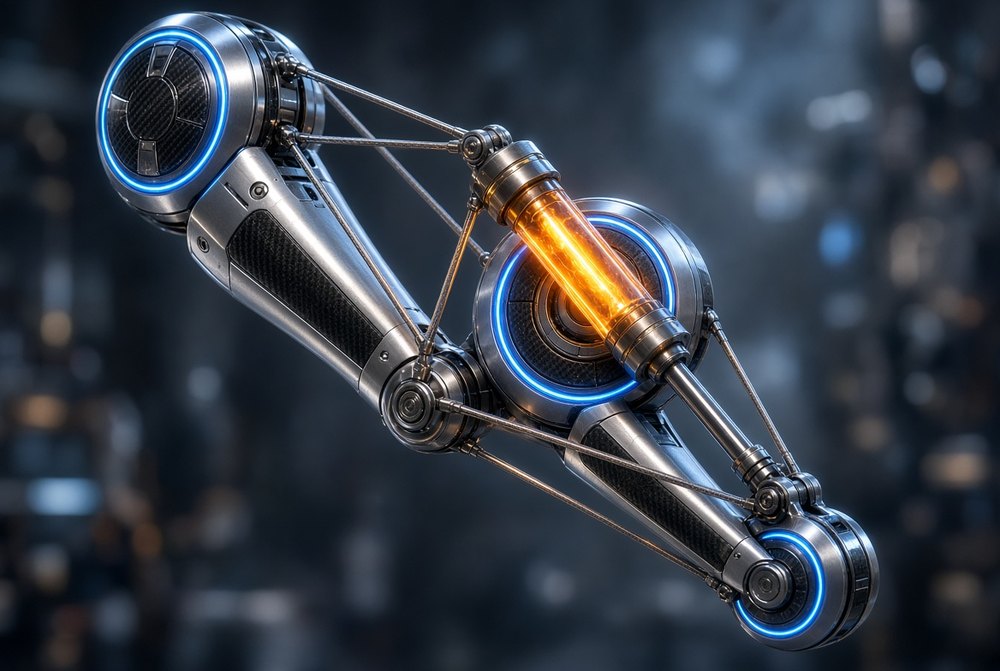
A Load-Bearing, Fluid-Mediated Robotic Joint Architecture Combining Variable-Geometry Friction Interlocks with Passive Multi-Stage Granular Jamming Inside a Tensegrity Compression Frame
This paper describes the QUINTO-CMC modular articulation architecture, built to hold high structural loads in contaminated or corrosive operating environments while cutting static holding power to a minimal telemetry-only draw. The system replaces high-maintenance, actively powered joints with an unpowered, field-replaceable cartridge that locks mechanically under zero electrical load. The physical joint module weighs no more than 1.75 kg. Static holding draw is limited to 18-25 W for telemetry and monitoring alone - the mechanical lock itself needs no electrical power. Three kinematically uncoupled passive locking layers trigger in sequence during pressure drops or sudden fluid loss. The primary retention tier uses a 4.5-degree self-locking mechanical wedge gate, where laser-etched micro-surfaces hold an operational friction coefficient of at least 0.11 nominal (0.095 as a conservative end-of-life floor) when submerged in a colloidal magnetic nanoparticle medium. The auxiliary tier deploys a granular particle-jamming core that triggers when system pressure drops below 3.0 MPa, giving an unpowered structural lock that stays disengaged through normal transient pressure dips down to 2.1 MPa. A radial friction stop forms the final safety boundary, limiting structural backlash to 0.5-degree. Hydraulic fluid routing runs through the internal hollow passages of the rigid compression struts in a structural tensegrity frame, keeping the high-pressure working fluid circuits fully separated from the dry tension network. This document records these mechanism combinations as prior art, protecting the disclosed technical baseline from third-party patent claims.
20 Multifunctional Solutions for Hydraulics and Structural Frameworks of Legged Robots: Self-Diagnostic Cartridge Valves, MRF and NiTi-Based Damping, Parametric Metamaterials, and Predictive Diagnostics
This document discloses twenty technical solutions for hydraulic drives, structural frameworks, and diagnostic systems of legged robots, unified by the design principle of a single physical element performing two or more functions simultaneously. These solutions encompass: self-diagnostic valves and seals utilizing impedance, piezoelectric, and NiTi mechanisms; damping and energy-recuperating structures based on magnetorheological fluids and liquid crystal elastomers; parametric metamaterial cells combining elastic, valving, and resonant functions; architectural designs for hardware-level hydraulic network survivability operating independently of electronics; cartridge interfaces with integrated opto-acoustic and electrochemical diagnostics; and a comprehensive structural joint architecture featuring three-level passive clamping and hydraulic lines routed internally through the load-bearing elements of a tensegrity framework.